
It is strange to think that not so long ago Germany was divided into East and West, separated by one of the most heavily fortified borders in the world. After reunification in 1989–1990 that border vanished, but only a few decades earlier the kind of travel I was now doing would have been impossible.
I had been to Hof many years ago. It is a small town of around 45,000 people that once lay in West Germany, very close to the inner German border. I remember little from that visit. It was one of those week‑long student exchanges: we visited them, and later they came to visit us. Wanting to leave those vague memories untouched, I decided not to stay in Hof this time and instead found accommodation in Schöneck, on what was once the eastern side.
I arrived there after a long drive from Berlin, passing through the westernmost corner of Poland along the way. Schöneck itself is close to the Czech border and is known for its small ski slopes in winter. In early December it was too early for skiing, though not too early for the cold. The car windows were frozen solid in the morning, as if they might remain that way forever. I had also been looking forward to the local aqua park, but the water turned out to be more suitable for serious swimming than for relaxed soaking.
The reason I keep returning to the idea of East and West Germany is that this area holds a curious geographical detail. Not far from Schöneck lies the point where East Germany, West Germany, and Czechoslovakia once met. Today it is marked only as a border point between Germany and Czechia, and as the meeting place of the German states of Bavaria and Saxony. There is a so‑called “three‑point chair” placed at the site, an attraction of sorts. What was once a hard geopolitical fault line is now just another quiet spot in the forest.
I noticed signs pointing toward this place as I drove past, and I admit I was tempted to stop. Still, I felt more committed to my own kind of attraction: the westernmost point of Czechia, located a bit further south. As usual, that commitment brought its own small complications. Approaching the site from the Czech side seemed more straightforward, but it was also possible from Germany—though how exactly was unclear. Forest roads crisscrossed the map, and it was difficult to know where to leave the car. One thing I did know was that I preferred not to cross the border by car. That could wait until later that day.
From the hotel in Schöneck I drove along quiet country roads, eventually reaching a nearly straight stretch of road about four and a half kilometers long. The view was broken by gentle rises and dips, but it was here that I realized this would not be as simple as I had imagined. All the small side roads I had noticed on the map turned out to be forestry roads where motor vehicles were not permitted. I would have to act quickly, choose a turn at random, park the car, and continue on foot.
From earlier trips I had learned that it made sense to switch the phone’s mobile network from automatic to manual and select a German operator. Otherwise the signal would constantly jump to Czech networks, making it harder to follow the map. It soon became clear that getting lost was unlikely. The roads were wide, well maintained, and clearly built for forestry machinery. I had even passed an active logging site a few kilometers earlier.
The walk from the car to the westernmost point of Czechia was roughly two and a half kilometers. I kept wondering how popular this place might be. I did not meet a single person on the way there or back, and I could not decide whether that was reassuring or unsettling. Then again, who would come here on a weekday in December? I also kept an eye on a stream shown on the map, assuming I would have to cross it at some point. In the end I did not. A thin layer of ice covered the water, but the route avoided it entirely.
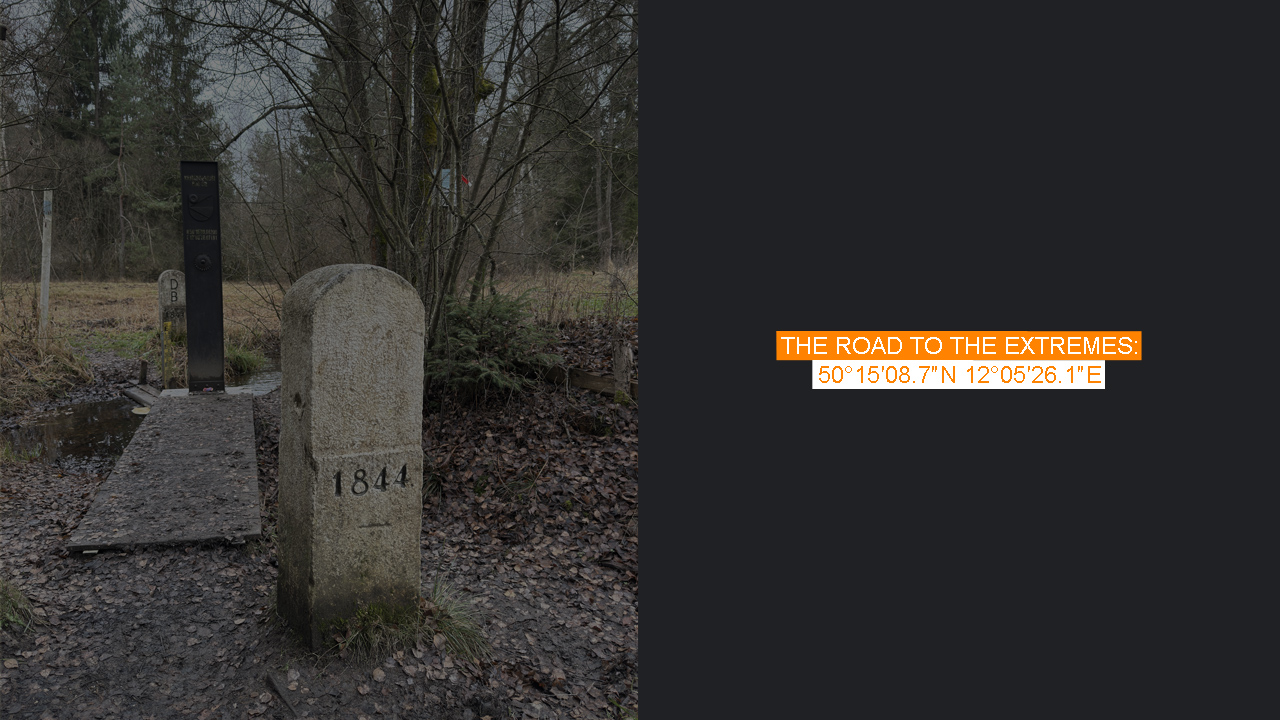
At the site itself there were border markers for both countries and a steel monument displaying the coordinates. What surprised me most, however, was the shelter. Built for hikers to rest and eat, it also had an upper level. It appeared sturdy enough to sleep in, protected from the elements. The idea that someone might spend the night here, exactly at the western edge of a country, felt oddly exciting.
My solitude was interrupted when five vehicles arrived from the German side along the same forest roads I had just walked. For a moment I was unsure what to make of it, but they turned out to be workers, most likely forestry crews. They walked past me, I greeted them, and soon they disappeared back into the forest.
I returned to the car by the same route. As so often happens, the walk back felt much shorter. Occasionally I could hear the distant rumble of Autobahn 93, a reminder that civilization was closer than the forest suggested.
Once back on the motorway, heading toward the lowest point of Czechia, I noticed thick dark smoke rising over the fields. As I drove past, the source became clear: a warehouse was on fire, sending massive clouds into the winter sky. It felt like a final reminder that even on the quietest journeys, anything can happen at any moment. I found myself briefly wondering how such an emergency would have been handled when borders here were still real obstacles. The thought passed quickly, replaced by a quiet sense of gratitude for how easily we move through Europe today.