
Berlin feels like it’s never going to end. Neighbourhood after neighbourhood, it just keeps going, and I had already started my journey from the eastern side of downtown Berlin. I don’t know what went through my mind, but I had booked an early pickup for my rental car at 8 a.m., the exact moment they opened. I could have shown myself a bit of mercy — I had flown in the night before, and by 7:30 I was already outside in the freezing cold, around zero degrees, without having eaten any breakfast.
I was there at eight sharp, first in line to pick up a car. They were quick. No papers to sign, no unnecessary explanations. Here are the keys, I’ll show you the car. Just the way I like it. The only problem was that the windows were completely frozen — and not just a light frost, but proper ice covering the entire car. The employee had a trick though: a spray bottle with some liquid that defrosted the glass instantly. For a moment I thought about saying that I wasn’t in a hurry anyway, that if the windows were this frozen the roads were probably worse, so why rush into morning traffic. But I figured he knew better and let him finish the job.
Back to Berlin, and my attempt to escape the metropolitan area. The Berlin–Brandenburg region has over six million people living in it — more than the population of Finland. It’s crazy. It really does feel like an endless city, although the slow morning traffic probably amplifies that feeling. Still, it’s a beautiful morning, frost clearly visible across the fields.
My destination is Osinów Dolny, on the very western edge of Poland, by the river Oder. With no autobahn, less than 80 kilometres takes more than an hour and a half. But in these conditions I don’t feel like I’m in a hurry, and I hope the other drivers agree. Eventually my patience is rewarded as dense city traffic turns into the familiar rhythm of 100 km/h stretches, slowing down to 50 or even 30 through towns, then back up again. The frequent speed traps make sure you stay alert — this is not a place to drive on autopilot.
At some point I reach a sign saying Chojna 28 km and PL inside a white circle. The sign points right, towards a bridge over the Oder. German customs are once again doing their work, stopping cars coming from Poland. There are surprisingly many police and customs vehicles for such a small crossing, and the queue from Poland into Germany looks long. For once, I’m driving a car with German plates, so they don’t seem interested in me — and why would they be, I’m heading into Poland. Still, I get a hunch they might stop me on the way back. Travelling alone always seems to trigger something.
The atmosphere on the Polish side is immediately different. Signs for cigarettes and other border shopping things appear. It feels like a small shopping town, but that’s not why I’m here. I take the first exit to the right, and within seconds I should be at the westernmost point of Poland.
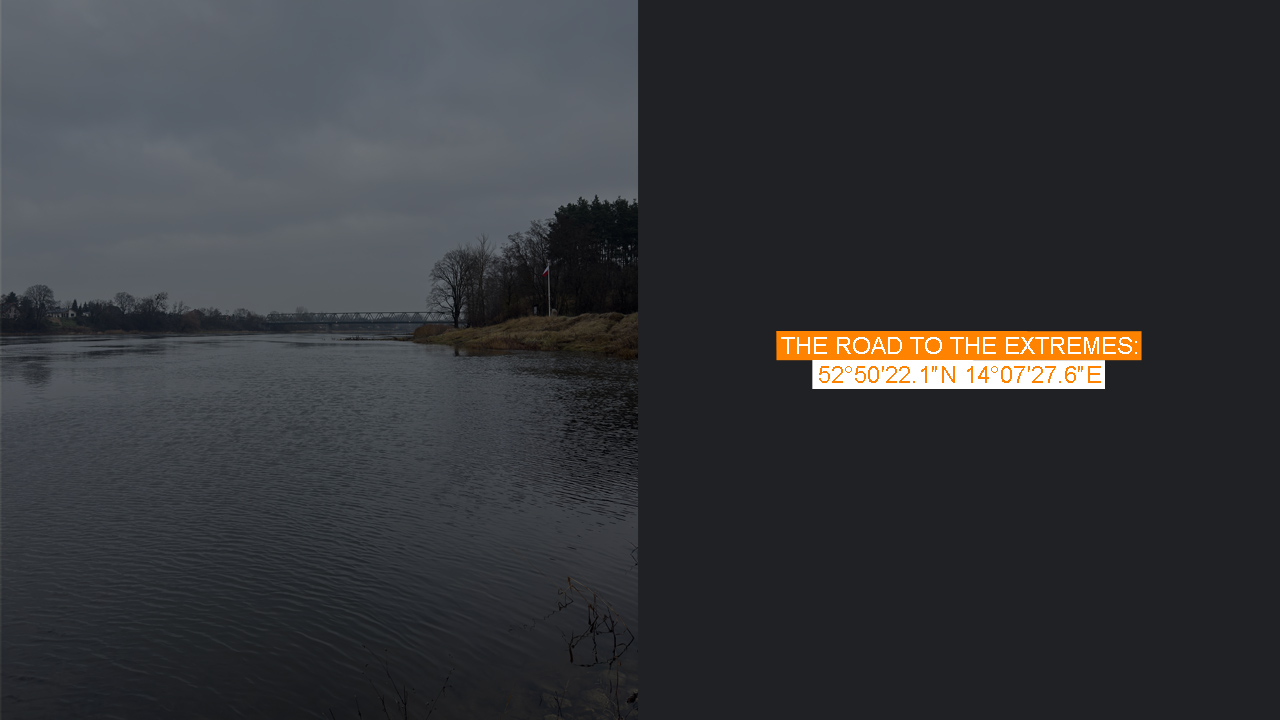
The westernmost point lies right by the river Oder. It’s easily accessible by car, with clear signs leading from the asphalt road. The last few hundred metres are on a gravel road that has probably seen better days. From there, you get a wide view across the river towards Germany. Somewhere on the German side, a rooster is crowing like crazy — either late to wake up or protesting the freezing cold.
The cold is biting. The river flows slowly in front of me, dark and heavy. You wouldn’t survive long in that water, I think to myself. It’s early December, and I’ve clearly dressed poorly. My thin beanie and gloves aren’t enough, but I try to enjoy the moment anyway. This is the westernmost point of Poland, after all. Still, enough is enough.
On the way back, my thoughts turn to the return crossing. Will the German customs stop me for some unnecessary check? They really shouldn’t — I’m driving a German-plated car. With these thoughts in my head, I retrace the same road. My visit to Poland has been short. Too short, really.
Back at the border, the queue into Germany is now much longer. Polish police patrol the cars coming from Germany, carrying massive machine guns. The line crawls over the bridge. I roll over a speed bump, and then a German officer raises a stop sign and directs me into a parking area. Suddenly, I’m surrounded by four officials. I explain that I only speak a little German. One of them takes my passport, driving licence, and the car papers and disappears. The others search the car and my luggage, looking for who knows what.
Eventually, they’re satisfied and let me continue. Thankfully, they don’t ask where I’ve been. Explaining that I crossed the border just to visit the westernmost point of Poland — visible from where we’re standing — would have been an odd conversation, and probably not one worth having.
Soon I hope to reach the autobahn, where the scenery starts changing more quickly. I want to reach my hotel before sunset. I’m heading towards a town called Hof, where I once spent a week almost two decades ago. This trip isn’t about revisiting the past, though. I’m on my way to explore the westernmost point of Czechia — my first extreme point in that country.
And that feels exciting.