
When I left for my road trip, I had absolutely no idea that I would end up in Poland, let alone in Gdańsk. The original plan was to visit the geographical centers of Sweden, Norway, and Denmark, followed by the westernmost point of proper Sweden and the southernmost islet of Norway. Those were the destinations I really wanted to explore—if the weather would permit. And it did, for a while.
Then the weather across Europe became unstable, especially in the Benelux countries, which had been some kind of dream destinations after those northern extremes. Suddenly it was all about finding a plan B—or driving back home altogether.
When my friend living in Berlin asked if we should go to Poland, I was hesitant at first. From the geographical center of Denmark to Berlin was already quite a drive. But the idea slowly started to grow on me. Why not? The weather forecast looked better, and perhaps there would be a chance to cross a few Polish extreme points off my list as well.
We met in Berlin in the afternoon. It was really just a pick-up and off we went—or almost. I booked a spa hotel for two nights while sitting in an ALDI parking lot, and then it was time for a much longer drive than I had expected. Driving on the motorway was completely fine and even somewhat sophisticated, but the problems started when we realized there wasn’t a motorway all the way to Gdańsk. They were still building it.
What followed felt like participating in a race filled with obstacles: Polish driving enthusiasm, lorries, incoming traffic, speed traps, and endless construction zones. You had to be brave and mostly guess what was going to happen next. It was also total destruction for the cars, but eventually—when day had turned into evening—we arrived in one piece. I was exhausted, very exhausted, but still had just enough energy left for some nighttime sightseeing.
Driving from Schwerin in Germany to Gdańsk via Berlin felt like a real achievement for one day. And Gdańsk, in a nutshell, was going to be more of a holiday than my usual trips, which tend to be nonstop movement from A to B to C. Gdańsk is a beautiful city, and sightseeing there feels pleasant—unlike many European cities nowadays, where avoiding crowds often feels wiser than diving in.
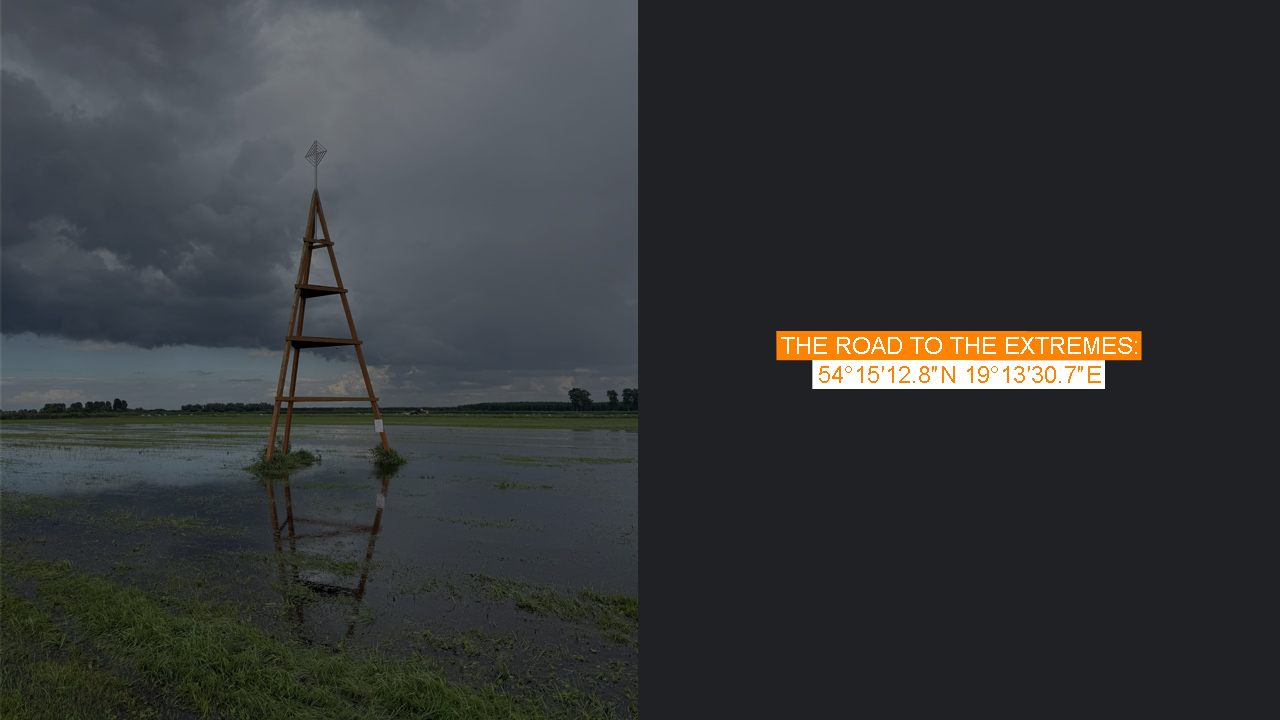
When my friend told me she had a job interview over Teams, I immediately knew what I would do. In Marzęcino, a small village southwest of Gdańsk, lies the lowest point of Poland. I was slightly confused at first, because another location—Raczki Elbląskie—kept appearing in references and seemed to be the more commonly visited spot. But after some research, I was able to confirm that since new measurements in 2022, Marzęcino is officially the lowest point. Raczki Elbląskie lies 1.8 meters below sea level, while Marzęcino reaches 2.2 meters below.
This came as a relief, since Marzęcino was closer to Gdańsk, and I didn’t have much time before my friend finished her interview.
So off I went. Once I managed to escape Gdańsk in one piece, it was motorway driving for a short while, until taking an exit at Nowy Dwór Gdański. That’s where the feeling of sophistication disappeared and the race began again. I don’t know whether it was just in my head, but people seemed to go completely bananas in towns. I was immediately tailgated. Still, somehow, once again, I managed to reach Marzęcino in one piece—but that’s where things became slightly more dangerous.
There was a tractor with a trailer ahead, and the car in front of me overtook it. I decided to do the same, only realizing too late that the tractor was actually indicating left. Thankfully, some small miracle happened: the tractor anticipated my move and stayed straight until I had passed. I was deeply embarrassed—and even more so when the tractor turned into the same place I was supposed to go.
It was a field road meant only for tractors, but there really was no other place to park. After turning around and driving back, I simply dumped my car there and decided to continue on foot.
It didn’t feel like a very good idea to leave the car. What if another tractor came? One might squeeze past, but not with a trailer—that would be impossible. And what if the tractor I’d just seen wanted to return? The crops—corn or something similar—were so tall that visibility was nonexistent. Still, I decided to make a quick visit and trust my luck.
Driving further didn’t feel like an option either. The surface was a mix of concrete slabs and rocks, clearly unfriendly without a 4×4, and turning around without reversing seemed unlikely. So I walked.
It was already muddy at the beginning, but the real struggle started after about 800 meters. It had been raining, and the ground was completely soaked. My beautiful yellow shoes were getting wet and dirty inside and out. Rubber boots would have been the only sensible footwear here. At the same time, I kept worrying about my poorly parked car. The only comfort was that although I couldn’t see the road or the car, I could still spot the tractor loading rolls onto its trailer.
As I got closer, it became clear that the entire area around the lowest point was flooded and underwater. Still, a wooden structure stood there, ready to greet any occasional visitors who made it this far. I stood there for a moment, taking it in, when I noticed dark clouds rapidly approaching. It was time to leave—before I would either be soaked completely or cause some kind of local chaos with my car.
I promised myself to drive more maturely on the way back to Gdańsk, and I kept that promise. Only later did I realize that there were actually signs leading to the lowest point all along—I had simply been too focused on staying on the road to notice them. And then it started to rain. I had visited and left the place just in time.