
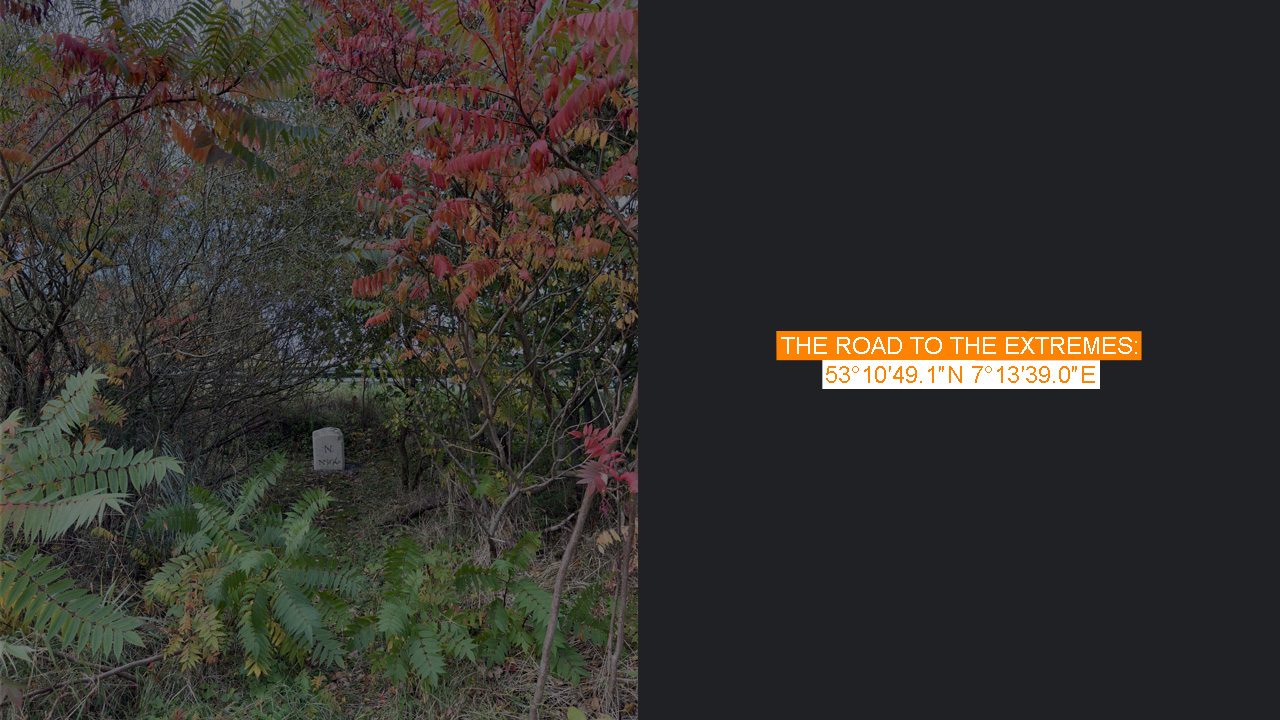
There is something oddly exciting about the easternmost point of the Netherlands, Bad Nieuweschans. And not because the point itself is anything extraordinary or dramatic. Quite the opposite, actually. It lies right next to a dual carriageway.
Hundreds—if not thousands—of people cross the border between the Netherlands and Germany here every single day, driving past this geographical extreme without acknowledging it at all. And that, to me, makes it far more fascinating. It is something completely different from many other extreme points in the Netherlands and elsewhere in Europe, which tend to be remote, less travelled, and require a deliberate effort to reach. Here, the opposite is true: people pass by daily, unknowingly brushing against the edge of a country.
I had done so myself months earlier. I was heading back to the Nordics from the Benelux countries after visiting the northernmost point of the Dutch mainland, just north of Groningen. The quickest route into Germany took me along the A7 motorway. As usual, the German police decided to carry out a border control—something they seem to enjoy—but that is another story. Once I was cleared and back on the road, I noticed that the easternmost point of the Netherlands lay just beyond the railing, only metres from the motorway. There was nowhere to stop, of course. This was a motorway, after all. Knowing I would be back in the Netherlands, I decided to leave it for another time.
That time came some months later. I had rented a car in Amsterdam and was on my way north to Germany, heading for the island of Sylt. Conveniently, the easternmost point of the Netherlands lay more or less along my route. It is near the town of Bad Nieuweschans—literally “Spa New Fortress” in English. Apparently, the word Spa was added to attract visitors, and to be fair, there are thermal baths in town that justify the name.
This time, however, I had no intention of crossing the border via the motorway. Instead, I chose a smaller, quieter crossing further south and planned to approach the point from the German side along backroads. Looking at the map, the border forms a strange little triangular shape here, as if geography itself hesitated for a moment.
Crossing into Germany via a tiny border road felt almost illicit compared to my earlier experience of being interrogated on the motorway. Explaining that I was travelling to see the easternmost point of the Netherlands would probably not have helped—judging by the confusion it later caused when I tried to explain a similar motivation to German customs during a visit to the northernmost point of Switzerland.
Soon enough, I reached a town called Bunde—a name that made me smile. It closely resembles the Swedish word bonde, meaning “farmer,” which felt fitting given the surrounding landscape. Today, everyone in Bunde seemed to be filling up their cars. There was a long queue at the petrol station, populated mostly by vehicles with Dutch licence plates. That, too, made sense: fuel was around forty cents cheaper in Germany.
Just after leaving the village, a maniac in a BMW overtook me aggressively, clearly offended by my adherence to the speed limit. What made it amusing was that almost immediately after overtaking me, he turned off into a driveway and disappeared. Very clever, I thought.
The extreme point itself turned out to be surprisingly accessible. An asphalt road led almost all the way there. Small drainage channels crisscrossed the area. And then there it was: the border marker. It stood beside one of the channels, barely a metre from the motorway railing. Cars flew past at full speed while I stood still, sheltered by bushes and surrounded by autumn-coloured leaves.
It felt slightly sketchy standing so close to the motorway, half-hidden in the vegetation, but I did not stay alone for long. Soon, a couple from the Netherlands joined me. They, too, had been unsatisfied with simply driving past on the motorway and wanted to see the actual point—the quiet, unassuming marker that thousands pass every day without noticing.
Standing there, with traffic roaring past and borders reduced to a small post in the ground, the easternmost point of the Netherlands felt exactly as it should: understated, absurdly ordinary, and quietly fascinating—though certainly not quiet.