
The German police and their way of controlling motorists’ speed can feel a bit sneaky. Mobile speed cameras tend to appear near cities, construction zones, and—most frustratingly—exactly where an unlimited Autobahn section suddenly drops to 120 km/h, then almost immediately to 100 km/h or even 80 km/h.
Of course, this is all done in the name of traffic safety, and those are precisely the places where speed control is justified. Still, placing a radar right at the beginning of a lower speed limit after an unlimited stretch feels borderline criminal—or at least slightly dangerous. Who actually slams on the brakes the moment a sign appears when they’ve been cruising at 200 km/h seconds earlier?
It gets trickier. Based on my entirely unscientific but extensive empirical research, the German police also seem to favor locations near national borders, just to make sure you leave the country with some kind of souvenir.
Naturally, this is exactly what happened to me.
I was driving in the far-left lane at around 160 km/h when I noticed the first 120 km/h sign. I lifted my foot off the throttle and carefully moved to the center lane, then to the rightmost one, making sure not to cut anyone off. While doing this, and focusing more on traffic than the signs, the speed limit dropped again—to 100 km/h.
That’s when I noticed people standing on the shoulder.
Of course. A mobile speed camera had just been set up, neatly positioned right behind the 100 km/h sign.
I felt a wave of fury. Had I really managed to drive straight into a speed trap and earn my first-ever speeding ticket in such a stupid and completely unnecessary way? My foot had been off the accelerator the entire time, but I hadn’t braked hard. Isn’t that supposed to be economical driving? The car was a hybrid with an automatic transmission—it certainly doesn’t slow down as aggressively as a manual would. Still, I knew the odds weren’t in my favor.
While these thoughts were running through my head, I was greeted by signs welcoming me to the Netherlands. It had all been going so well—until now.
Then again, to be honest, there had already been some struggles earlier.
I had left Münster only to realize that my planned route would take me through Germany’s environmental zones. Since the car was registered in the Netherlands, I hadn’t bothered getting one of those environmental stickers required for driving in certain cities. Following the GPS blindly, I suddenly found myself wondering whether I had accidentally entered such a zone—something that isn’t exactly easy to verify while driving.
Around Oberhausen and Duisburg things can get confusing, even though motorways are officially excluded from these zones. Still, unsure and unwilling to risk a fine, I ended up taking a detour through the countryside. When I finally rejoined the motorway, I promptly ran into the speed trap.
The good news is that minor speeding violations in Germany are relatively cheap. The bad news is that once the rental company adds its administrative fees, the price becomes noticeably less amusing.
Eventually, still replaying the incident in my mind, I continued into the Netherlands toward Maastricht—or more precisely, toward one of the country’s geographical oddities. This is where the Netherlands narrows to its slimmest point, less than five kilometers wide. To the west lies Belgium, to the east Germany, and to the north the country suddenly widens again into something resembling a round-bottom flask.
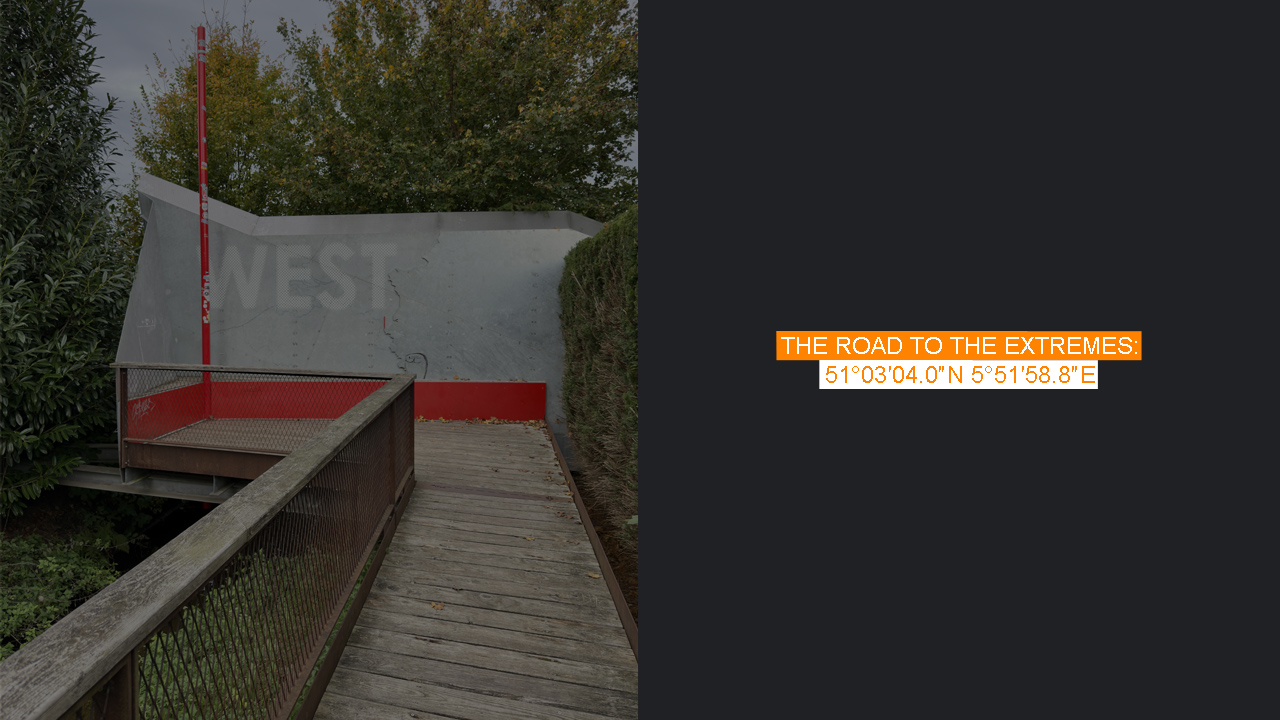
This narrow neck is also home to another extreme point: the westernmost point of Germany.
The westernmost German town is called Isenbruch. Arriving from the Netherlands, you cross the border and immediately find a small parking area on the right. From there, the border follows a small stream called the Rodebach southward. A short walk back north, across a wooden footbridge, leads to the actual extreme point.
A couple of nearby houses are protected by massive plant fences, and a modern monument marks the spot, proudly celebrating the fact that you have made it all the way to the western edge of Germany
By the time I reached the monument, I had once again proven that reaching an extreme point is rarely about the place itself. It’s about everything that happens on the way there.
Standing there, next to an unremarkable stream and a perfectly modern monument, it struck me how little effort the actual extreme had required. No hike, no ferry, no frozen sea. Just a motorway, a parking spot, and a short walk.
And yet the journey had still managed to test my patience far more than most remote places ever had. I had driven over 700 kilometers from the very northernmost point of Germany, with only an overnight stop in Münster.
Whether a speeding ticket would eventually arrive in the post remained a mystery.