
I was standing on the highest point of Luxembourg with the familiar realization settling in: I had messed up again. The evening before, in a rare moment of responsibility, I had booked a hotel room near Freiburg im Breisgau so that—for once—I would actually know where I was heading. The reception closed at 10 p.m., which shouldn’t have been an issue. But the adventures of the southernmost point of Luxembourg, then the southernmost point of Belgium, then the westernmost point of Luxembourg, and finally the northernmost point of Luxembourg had devoured my entire day. I had already fooled myself into thinking I could do it all; my schedules are more aspirational than realistic.
Now my ETA was fifteen minutes past closing time—and that was without any stops. In theory I could claw back a few minutes on the autobahn, but even Germany can’t bend time. The sun was already sinking. I checked whether the hotel could be cancelled. Of course not. Then I looked at their website and discovered that the reception might actually close at 9 p.m. Even better. Confusing, contradictory times everywhere.
The route would take me toward Trier, then Saarbrücken, then briefly into France before looping to Offenburg. With all these border crossings, I felt certain at least one German police patrol would want a look at my passport—after all, I was driving a Dutch-plated rental car. I decided to deal with the hotel on the way and attempted a phone call.
It did not go well. First attempt: the person picked up, I managed to say who I was, and then the line died. Second attempt: same thing. My phone was clinging stubbornly to a Luxembourg network, which of course worked terribly once I crossed into Germany. I didn’t feel like troubleshooting roaming settings while driving on autobahn, so I detoured to a rest area.
There I wrote an email to the hotel explaining I might arrive late. I also noticed they had sent me an online check-in form—an extremely German questionnaire—asking for a copy of my passport. Normally I’m cautious about where I send passport scans, so I simply photographed the cover and hoped it would satisfy their bureaucracy. Then back to the road.
I’d been in similar situations before, so I wasn’t overly stressed, but it would have been nice to know whether I actually still had a room. Their website mentioned a key-locker system for late arrivals, but no confirmation had come. I kept refreshing my inbox.
Later I tried calling again. This time a woman answered but didn’t speak English, so she passed the phone to a man. He told me the reception was already closed and that there was no booking under my name. I checked the confirmation: correct date, correct hotel. He still couldn’t find it. Likely wanting to end the call, he simply said, “Just come to the hotel, we’ll figure it out,” assuring me that arriving after 10 p.m. would be fine.
It wasn’t exactly reassuring, but at least it allowed me to focus on driving into the pitch-black evening.
In Saarbrücken the fun continued. German cities love their environmental zones, and because my rental lacked the required sticker, I had to thread my way around them. Google Maps and Waze both love rerouting you without telling you, which is great until a road closure forces you into the exact zone you’re trying to avoid. I took a wrong turn, made an involuntary tour of suburban Saarbrücken, and came dangerously close to following a car straight through a red light.
Eventually I escaped the maze and reached the German–French border, where roadworks had turned everything into a dimly lit construction zone. Other drivers continued straight; I followed a smaller road to the right and was suddenly alone in total darkness. With high beams on, I spotted a cluster of French police cars parked silently beside the road—completely invisible without extra light. I crawled past them at the posted 30 km/h and soon merged onto the French motorway toward Strasbourg.
By then it was hopeless: I wouldn’t reach the hotel on time. When I finally neared Strasbourg, I again had to navigate carefully to avoid the city’s environmental zone. I succeeded, re-entered Germany, and this time found the border guards apparently off-duty. A short autobahn sprint later, I left the motorway and approached the hotel.
I arrived at around 22:30. The building—an Alpine-style chalet tucked into the Black Forest—was completely dark. The restaurant, supposedly open a bit later, was equally lifeless. A flash of panic hit me: the man on the phone had promised I could arrive late. Yet here I was, standing in the dark, no way to get inside.
Then I noticed a new email. They had responded. And they had acknowledged the reservation. They’d even sent a code for a key locker. After some searching, I located the box, retrieved the key and found my way inside a silent hotel. The room was cozy and warm—perfect after such a chaotic evening. I brought in my bags, showered, and collapsed into bed.
The next morning the hotel looked entirely different. Sunlight revealed the gentle folds of the Black Forest hills. At reception the owner greeted me by my last name before I even spoke—very German—and directed me to breakfast. I sat alone at a table laid with perfect white linens until other guests eventually appeared. After a surprisingly formal checkout, I hit the road again.
The Black Forest was stunning in daylight, though intermittent rain and work calls interrupted the serenity. Once again a closed road forced me onto a tiny rural lane climbing toward a ridge. Leaves covered the pavement, and I kept imagining what would happen if a tractor came barreling down. Thankfully none did. At the top, fields opened around me, and the views were magnificent.
I tried to drive closer to my destination, but a small road running along the German–Swiss border was explicitly closed to motor vehicles. So I parked by the fields and debated whether to take my rain jacket. The sky looked uncertain, but laziness won: I left it behind and walked uphill beneath humming power lines.
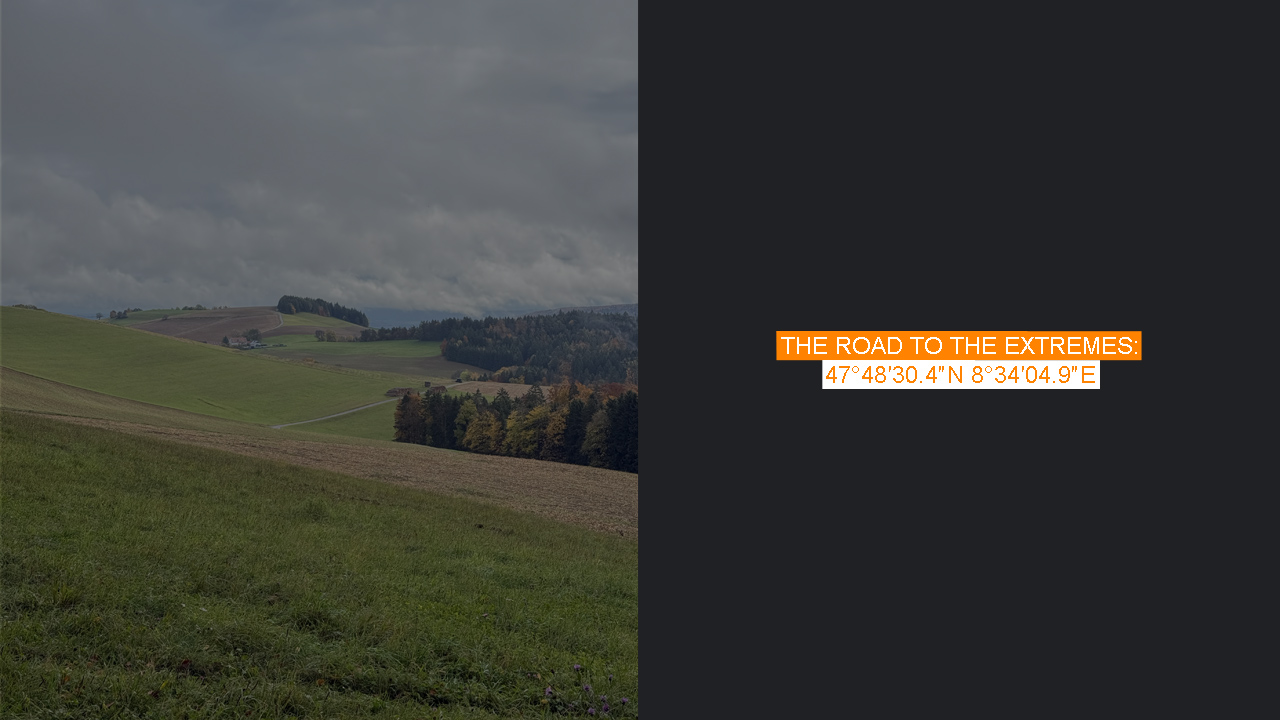
After about a hundred vertical meters, I reached what I had come for: the Black Stone, the northernmost point of Switzerland, a sharp corner where the border suddenly hooks south. On the Swiss side: dense forest. On the German side: sweeping farmland. Someone had even installed benches and a grill—apparently this is a summer hangout spot.
Eventually I headed back down the narrow road, stopping briefly at a viewpoint overlooking the western Black Forest. I double-checked the electronic handbrake several times; if the car rolled, it would probably roll forever.
Back in the village, a roundabout awaited—and with it, German customs. A Dutch-plated rental car arriving from the Swiss border? Of course they stopped me. They asked whether I had been in Switzerland. “No.”
“Where have you been then?”
I attempted to explain I had simply gone on a little hike to a border marker. My hesitant explanation didn’t convince them, so they directed me to a more thorough inspection.
Three armed officers approached. First they asked for my passport and driver’s license. I offered to show them a picture of the border stone on my phone. One officer immediately recognized it and explained to the others: “Ah, the Black Stone.” They had apparently assumed I was heading there, not returning. I told them the hike was already done.
They still inspected my passport, then opened the trunk. They rummaged through my bags, discovering my allergy medicine, which sparked a small discussion. And so my morning ended with a border check at a village roundabout—just another strangely fitting episode in my collection of “completely normal” travel days.