
I wake up in what feels like the middle of nowhere — Contrexéville, France. Less than twenty-four hours earlier, I hadn’t even heard of the place, and now here I was, having spent the night in it. Just the day before, I had visited the easternmost point of France, not far from Karlsruhe, Germany. I felt reasonably content with how the trip had gone so far, even though things hadn’t exactly gone according to plan. I hadn’t managed to reach all the places I’d mapped out in my mind — but then again, that’s travel.
Still, there was one spot I couldn’t skip: the lowest point of Belgium. I had missed it during my summer journey across the Benelux countries. Normally, it wouldn’t have mattered much, but it happened to be right next to De Panne — the westernmost point of Belgium and the northernmost point of France — both of which I had visited. How I managed to miss it then, I still don’t quite understand. But missing it meant I couldn’t simply drive straight up to Amsterdam, where I was supposed to return my rental car and fly home. From Contrexéville, the direct route north to Amsterdam was tempting, but De Moeren, where the lowest point lies, offered a compelling detour to the Belgian coast.
But how did I even end up in Contrexéville?
The night before, I’d been searching for accommodation somewhere near the easternmost point of France. Sitting in a parking lot, I decided I wasn’t keen on driving through the dark yet again. I wanted a hotel close enough — but ideally also positioned so that I could theoretically consider visiting the geographical center of France, which, naturally, sits somewhere in the middle of the country. The idea was absurd, of course: it was another four hours from Contrexéville, and then six more from there to De Moeren. But I wanted to keep my options open.
Eventually, I stumbled upon a hotel that looked like a small palace and booked it.
By that point, I’d been pushing hard — hundreds upon hundreds of kilometers on the road, long days, quick snacks instead of proper meals. I had to remind myself this was supposed to be a holiday. So I made peace with the fact that the geographical center of France would have to wait. It wasn’t going anywhere.
In the morning, I handed back the key to the friendly, cheerful people at reception and stepped outside. A thick branch had fallen from a nearby tree, landing just beside the car. Luck or misfortune? Hard to say — but definitely luck in that it hadn’t hit the rental.
At the gas station, I filled up the tank and then stopped by a massive supermarket that had just opened. “Today,” I thought, “I’ll have an early lunch.” People looked at me as though I’d arrived from another planet — which, in a sense, I had. I tried to pay for my baguette at the self-service checkout, but of course something went wrong. A woman hurried over and explained something in French. I didn’t understand a single word, yet somehow gathered that baguettes apparently had to be bought from the real cashier. To this day, I have no idea why.
Contrexéville, as it turns out, is known for its mineral springs — in fact, Nestlé bottles water from here. But for spa enthusiasts like me, the town’s real charm lies in its spa and health resort culture, which dates back to the late 18th century. I’ll admit, it bothered me a bit to leave such a place behind. Still, I wanted to reach De Moeren and my last accommodation before sunset.
The 550-kilometer drive to the Belgian coast doesn’t leave me with many clear memories — perhaps because there wasn’t much to remember. I avoided Paris by heading first through Luxembourg, then cutting northwest toward Calais. It rained occasionally, and somewhere in Belgium I passed a fresh accident: someone had rear-ended a Porsche Panamera, the police not even there yet.
Driving on Belgian motorways is oddly pleasant. Many stretches use average-speed radar controls, so you can set the cruise control, stay in the left lane, and relax — no one tailgating, no chaos.
I had booked a hotel in Middelkerke and arrived just after check-in began at three. The receptionist who spoke English was stunningly beautiful — the kind of beauty that makes you briefly forget what you were about to say. I wanted to tell her so, but these days it’s hard to know how such compliments are received. So I simply thanked her for the key, checked my room, and headed back out toward De Moeren. I didn’t even bother unloading my things.
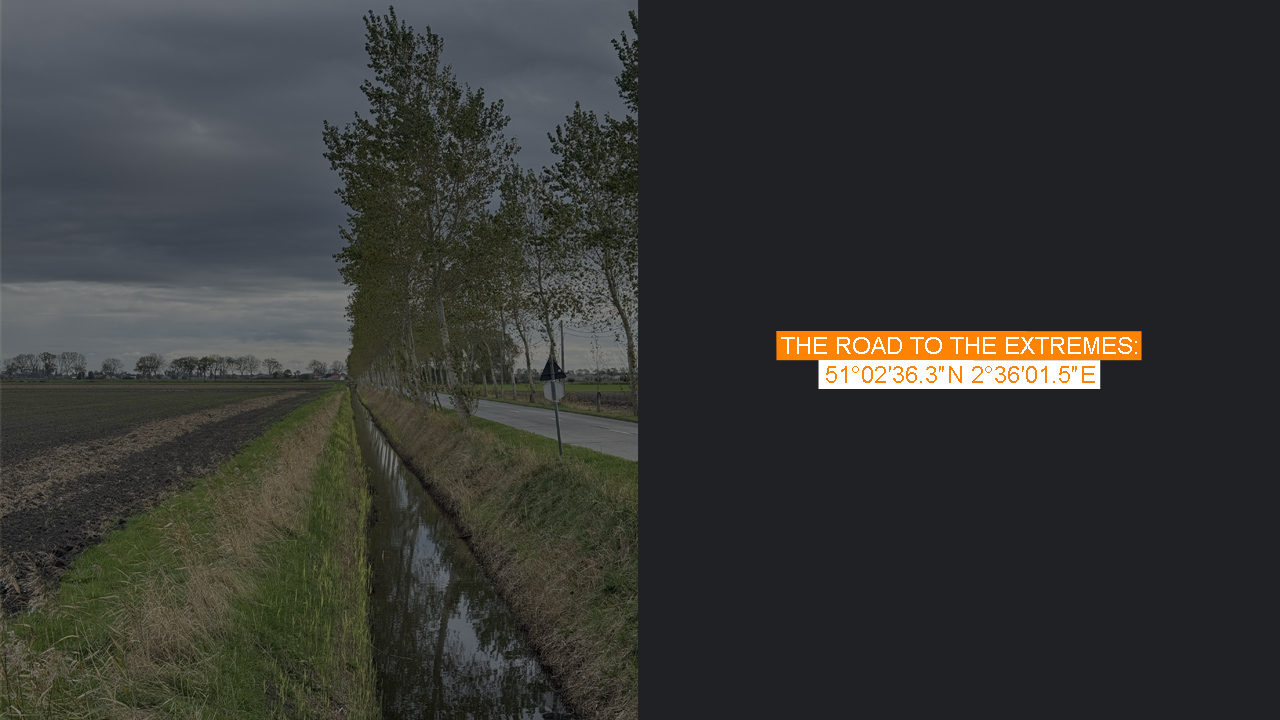
The drive to De Moeren took about half an hour, through flat, windblown fields. After doing some research, I’d learned that no exact coordinates mark Belgium’s lowest point. Instead, the entire polder area of De Moeren — roughly 3,200 hectares of farmland — sits two to three meters below sea level.
Centuries ago, it was an expanse of freshwater lakes and marshes. In the 17th century, twenty windmills drained the lowlands, pumping water into the surrounding “Ringslot,” or ring ditch. Even today, the land bears their mark: vast rectangular plots divided by straight ditches and roads, an orderly grid etched across the reclaimed landscape.
Standing there, at Belgium’s lowest point, I felt the quiet satisfaction of having closed a loop — the final stop of a journey that had zigzagged across borders and plans, guided as much by curiosity as by chance.
Back in Middelkerke, I still hadn’t decided whether to visit the nearby swimming hall or simply enjoy the bathtub in my room. Either way, it was finally time for a little bit of proper holiday.